- QUICK MENU
- Focus and Scope
- Author Guidelines
- Peer Review Process
- Publication Ethics & Malpractice Statement
- Publication Fees
- Publication Frequency
- Copyright Notice
- Plagiarism Policy
- Open Access Policy
- Archiving
- Indexing and Abstracting
- Retraction, Withdrawal & Correction Policies
- Generative AI Policies
- Accreditation Certificate
- Author Declaration Form
- Collaboration and Association
Home
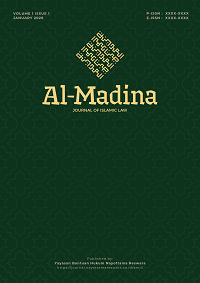
Al-Madina: Journal of Islamic Law
e-ISSN: xxxx-xxxx | p-ISSN: xxxx-xxxx
Journal Initials: Al-Madina
DOI Prefix: -
Publisher: Yayasan Bantuan Hukum Nayottama Reswara
Frequency: Biannual (March and September)
Speed: 30 Days Avg. from Submission to First Decision
Editor-in-Chief: Zul Fahmi 


Citation Analysis: Google Scholar |
Al-Madina: Journal of Islamic Law is a peer-reviewed scholarly journal dedicated to the study and advancement of Islamic law (Sharia) across its theoretical, doctrinal, and practical dimensions. The journal publishes original, evidence-based research that examines both classical jurisprudential traditions and contemporary legal developments, fostering critical dialogue on interpretation, implementation, and reform of Islamic legal norms in modern societies. Manuscripts should demonstrate clear scholarly contribution, methodological transparency, and engagement with relevant literature.
Al-Madina: Journal of Islamic Law welcomes rigorous scholarship across a broad range of topics in Islamic law, including but not limited to: Islamic Family Law (Ahwal al-Syakhshiyyah), Islamic Criminal Law (Jinayah), Islamic Constitutional and Administrative Law, Islamic Economic and Financial Law (Muamalah Syariah), Comparative Law and Legal Pluralism, Contemporary Fiqh Issues, Human Rights and Justice in Islamic Legal Perspective, and Methodology of Islamic Jurisprudence (Usul al-Fiqh). Contributions that address these fields from doctrinal, historical, comparative, theoretical, or empirical perspectives are particularly encouraged.
The journal also welcomes submissions on related legal matters that intersect with Islamic law, including interdisciplinary research connecting legal doctrine to social, political, and economic realities in Muslim societies, policy-oriented analyses, and practitioner-led studies. Works that engage contemporary challenges, reform debates, and the application of Islamic legal principles within plural or mixed legal systems are invited, provided they meet high standards of scholarly rigor and originality.
Al-Madina: Journal of Islamic Law warmly invites academics, researchers, legal scholars, and practitioners from Indonesia and internationally to contribute original articles, review essays, and practitioner reports. Through this platform, the journal seeks to foster global scholarly exchange, comparative reflection, and collaborative research on the development and application of Islamic legal thought in diverse cultural and legal contexts.
Al-Madina: Journal of Islamic Law is published biannually with Issue 1 (March) and Issue 2 (September). Each issue typically contains five (5) research articles. The journal accepts submissions in English only. Submissions are accepted year-round; all manuscripts undergo a rigorous double-blind peer review process to ensure the highest standards of academic quality and ethical integrity. Accepted articles proceed to copyediting, proofing, and final publication.
For submission guidelines, publication policies, ethical statements (including policies on authorship, plagiarism, AI use, corrections, and archiving), and detailed instructions for authors, please consult the journal’s Policies pages on the website.
Editorial Office
Al-Madina: Journal of Islamic Law
Published by Yayasan Bantuan Hukum Nayottama Reswara
Jl. Kol. H. Nurdin, Panyabungan Jae,
Panyabungan District, Mandailing Natal Regency,
North Sumatra Province, Indonesia, 22917
Email: shishya@nayottamareswara.co.id
Website: https://nayottamareswara.co.id/index.php/amjil
© 2024 Nayottama Reswara — All rights reserved.